About Me
Hi, I’m Heejo Jeong, a Ph.D. student at the University of Melbourne,
supervised by Professor Taehyun Rhee and co-supervised by Dr Gabriele Marini.
I received my M.S. in Computer Science and Engineering from Korea University,
where I specialized in computer graphics and physics-based animation.
My research interests include real-time graphics and realistic, interactive visual computing.
You can find more details about my academic background and experience in my CV.
Education
University of Melbourne, Melbourne, Australia
Doctor of Philosophy (Ph.D.)
(May 2026 – Present)
Principal Supervisor: Prof. Taehyun Rhee
Co-supervisor: Dr Gabriele Marini
Korea University, Seoul, Republic of Korea
M.S. in Computer Science & Engineering
(Sep 2023 – Aug 2025)
Advisor: Prof. JungHyun Han
B.S. in Civil, Environmental & Architectural Engineering
(Mar 2017 – Aug 2023)
B.S. in Artificial Intelligence (Interdisciplinary Program)
Undergraduate period includes 2 years of mandatory military service
Publication
Momentum-preserving Inversion Alleviation for Elastic Material Simulation
Heejo Jeong, Seung-wook Kim, JaeHyun Lee, Kiwon Um, Min Hyung Kee, and JungHyun Han,
Computer Animation and Virtual Worlds (CAVW), Vol. 35, No. 3, May 2024, pp. e2249. DOI ·
Experience
Research Intern
Collaborated with Prof. Kiwon Um on differentiable physics and data-driven simulation methods.
at Télécom Paris, Institut Polytechnique de Paris, France (Jan 2025 ~ Feb 2025)
Military Service
Republic of Korea Army
(Aug 2020 ~ May 2022)
Projects


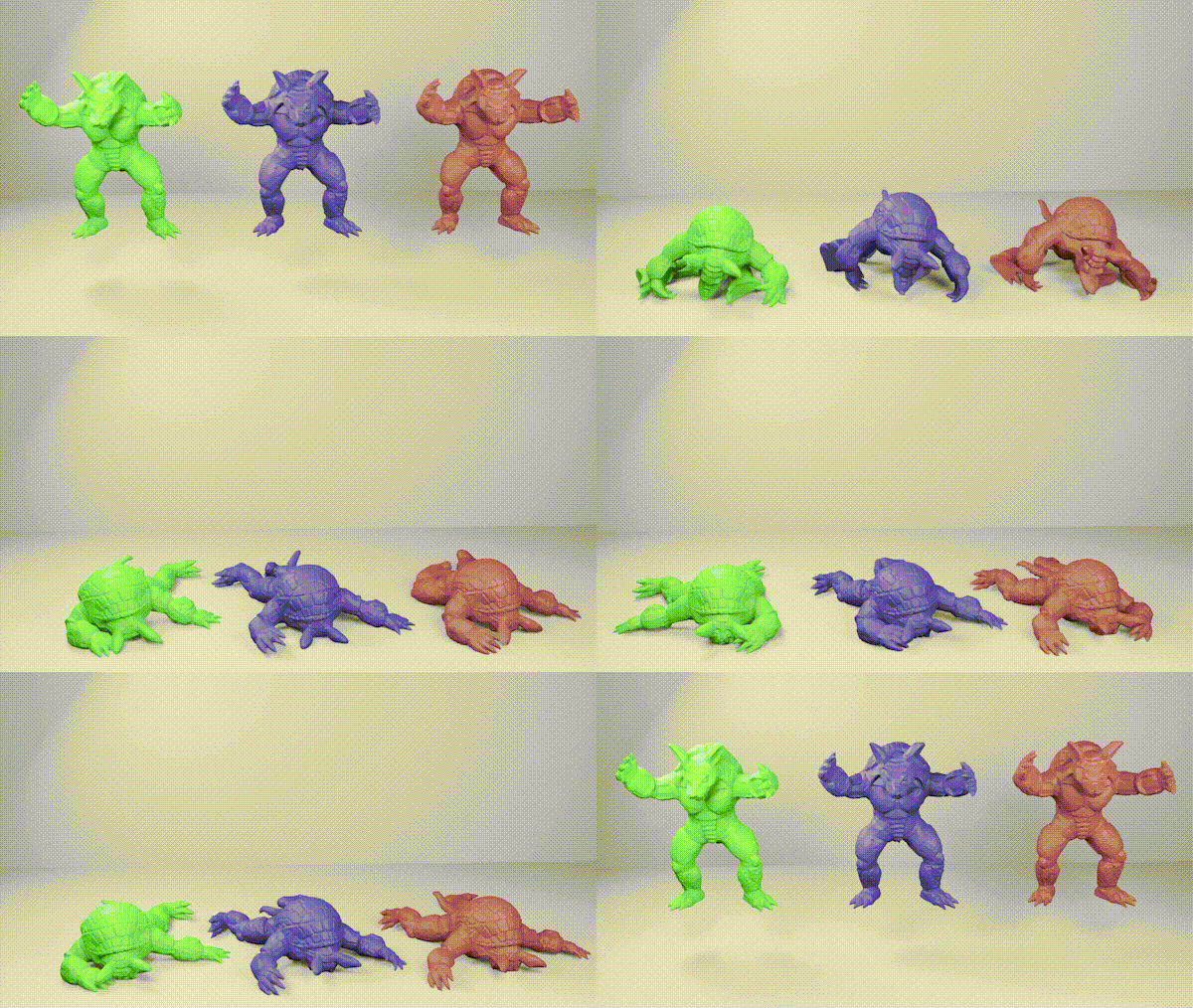
A neural network is inserted into the XPBD physics engine so it can learn realistic soft-body behaviour (like rubber or flesh) from just a few example motions, replacing tedious hand-tuned material formulas.



A 2-D stable-fluid solver originally prototyped for an LG Electronics project on real-time air-conditioning airflow visualization in the metaverse. Implemented in Taichi for GPU-accelerated Conjugate gradient method